
A hedge is either sharp or it is not. We cut to a straight line and an even face, shaped to suit the hedge, and the clippings cleared.
No commitment. We call, you decide.
The short answer
Hedge trimming is cutting a hedge back to a defined shape, with a level top and even faces, so it stays dense and holds its line. Hedge shaping goes further and rebuilds the form of a hedge that has lost it. Weeds n’ Wonders provides both across Melbourne’s eastern and north eastern suburbs.
Depending on the hedge, its species and growing conditions, a slight taper may be beneficial, with the base kept slightly wider than the top. This can help more light reach the lower foliage and encourage dense growth from top to bottom. Not every hedge requires the same shape. Some are better maintained with straighter faces, while others benefit from a more noticeable taper. We shape each hedge according to its growth habit, condition and the finish the client is looking for.
A lot of Melbourne hedges are green on top and sticks underneath. Usually that is not age and it is not disease. It is how the hedge has been cut.
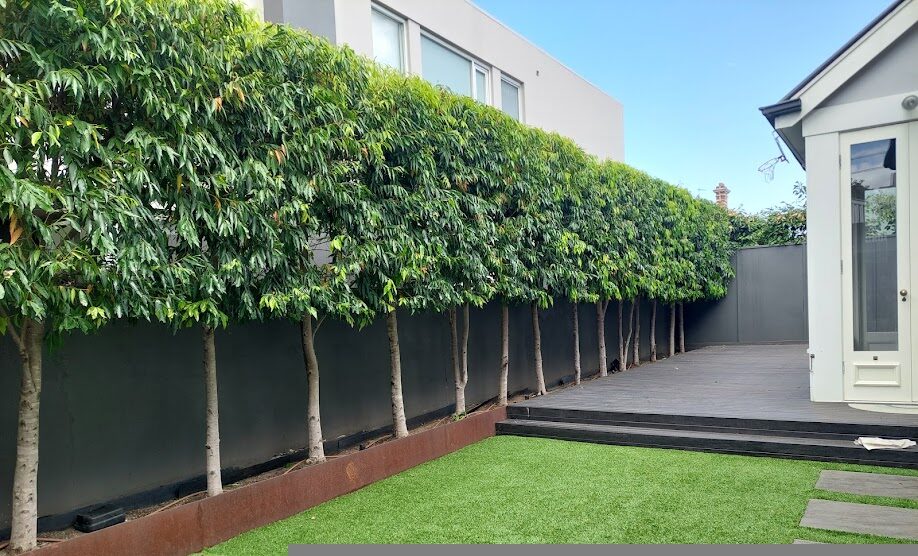
A hedge cut to line and level. Our work, our photo.
What you get
Straight faces, level top, and the shape the hedge actually needs.
Blades kept sharp so leaves are cut rather than torn, which is what causes brown edges on large leaf hedges.
Growth cut back off fences, gutters, paths and coming from your neighbour's side.
Hedge clippings are the worst waste to be left with. Your green bin first, then we bag and take the rest at $8 a bag.
If it is thinning, diseased or planted somewhere it will never work, we tell you.
Method
These are different jobs with very different risks. Cutting the wrong hedge hard can kill it outright, so the plant decides, not the calendar.
| The hedge | What it needs | Why |
|---|---|---|
| Trimmed in the last year, holding its shape | Regular trim to the existing line | Light, frequent cutting is what keeps a hedge dense. Take a little often and it thickens. |
| Overgrown by a season, shape still visible | Trim back past the old line | Cutting slightly inside the previous line restores the shape without going into bare wood. |
| Overgrown for years, broadleaf plant such as ficus, photinia, laurel or lilly pilly | Hard cut back or staged renovation | Many broadleaf hedges can regenerate from older wood, allowing an overgrown hedge to be reduced and reshaped. |
| Overgrown conifer, such as cypress, thuja or leyland | Trim only into green growth. Do not cut into bare wood | Conifers have difficulty reshooting from bare wood. Cutting beyond the green growth can therefore leave permanent bare patches. |
| Bare at the base, green on top | Reshape to let more light in, then be patient | Reshaping can let more light reach the lower growth. Broadleaf hedges will often refill over the growing seasons, though recovery depends on the species and its condition. |
| Diseased or dying in patches | Diagnosis before any cutting | Trimming a diseased hedge can spread it. Box hedges in particular need identifying before blades go near them. |
We will tell you honestly if a hedge cannot be saved. Replanting a failed hedge is cheaper than three years of trying to rescue it.
Local knowledge
Most hedges in Melbourne’s east are one of these. Each has a different growth rate and a different tolerance for being cut hard.
| Hedge plant | Where you see it | Best timing | Will it reshoot from bare wood? |
|---|---|---|---|
| English and Japanese box | Formal low hedges and borders, common in Kew, Hawthorn and Toorak | Late spring and late summer | Yes, but slowly. Watch for box blight before cutting. |
| Photinia, often Red Robin | Fast screening hedges across all six suburbs | After each flush of red growth | Yes, reliably. One of the more forgiving hedges. |
| Lilly pilly | Very common modern screening hedge | Spring and late summer | Yes. Older varieties are prone to psyllid, which pits the leaves. |
| Portuguese laurel | Established formal screening on larger blocks | Late spring and early autumn | Yes, tolerates hard cutting well. |
| Viburnum | Dense screening hedges, often older gardens | Late spring and late summer | Yes, vigorous and forgiving. |
| Pittosporum, including Silver Sheen | Narrow screening in tight spaces | Spring and autumn | Yes, though it can go leggy if left too long. |
| Murraya | Fragrant screening hedges in warmer, sheltered spots | After flowering | Yes. |
| Camellia sasanqua | Hedged screening in shaded gardens | Straight after flowering finishes | Yes, but cut it before it sets next season’s buds. |
| Westringia and native hedges | Low native and coastal style hedges | Through the growing season | Poorly. Keep it to light, frequent trims and never cut hard. |
| Conifers, including cypress, thuja and leyland | Tall boundary screening, older properties | Spring and early autumn | Avoid cutting into bare wood. It struggles to come back. |
| Ficus, including Ficus hillii | Large formal screening hedges on bigger blocks | Through the growing season | Yes, vigorously. Watch the root system near paving and pipes. |
Not sure what you have? Send us a photo. Getting the species right matters more with hedges than with anything else in the garden, because the wrong cut on the wrong plant does not grow out.
The pattern
Bare or thinning growth at the bottom of a hedge can have several causes, from lack of light and previous pruning to growing conditions and the hedge species itself. Identifying why it is happening is important, because the right approach, and whether the bare areas can regrow at all, depends on the cause and the type of hedge.
Dense upper growth can sometimes shade the lower parts of a hedge, reducing the amount of light reaching the foliage and contributing to thinning at the base.
Repeated or overly hard pruning can leave some hedges with limited healthy growth behind the outer foliage. How well they recover depends on whether viable growth remains.
Shade, competition for water and nutrients, plant health and the natural growth habit of the hedge can all contribute to thinning or bare areas.
There is not one solution for every bare hedge. Depending on the species and condition, we may adjust the shape of the hedge, the trimming height or the pruning approach to encourage healthier growth.
Rhythm
There is not one trimming schedule that suits every hedge. How often a hedge needs attention depends on the species, how quickly it is growing, the time of year and how formal or natural the desired finish is.
Fast growing hedges such as lilly pilly, photinia and ficus may need more regular attention during active growth, particularly where a crisp, defined shape is important. Slower growing hedges, or those maintained in a more natural form, may need less frequent trimming.
Rather than trimming simply because a certain amount of time has passed, we look at the growth, condition and intended shape of the hedge. Regular, lighter trimming can help maintain a defined hedge without repeatedly having to remove large amounts of growth.
Many clients fold hedge trimming into a regular garden maintenance visit at the right times of year, so it simply happens without being booked.
Pricing
We charge $180 an hour, with a $180 minimum for a visit. That rate covers two gardeners, which on a hedge means one can hold the line while the other clears as we go. Hedges are not priced by the metre, because length is only part of it. Height, access, how long the hedge has been left and what species it is all change the time it takes and the care it needs.
Large hedges, tall boundary screening and full reshaping of a neglected hedge are quoted separately, because they may need more time than a standard visit allows.
Get a call back and we will tell you what the hedge needs and confirm the cost with you before any work starts.
Before and after
Real hedges we have brought back into line across Melbourne’s east. Every photo is our own work.
Overgrown border reshaped, line reset and levelled along the full frontage.
Screening hedge cut back off the path and reshaped to let more light into the base.
Reviews
Rated 5 out of 5 on Google.
Service areas
Weeds n’ Wonders provides hedge trimming and shaping in the following suburbs.
Hedge trimming in Kew
Hedge trimming in Camberwell
Hedge trimming in Hawthorn
Hedge trimming in Balwyn
Hedge trimming in Ivanhoe
Hedge trimming in Toorak
Nearby but not listed? Call us. If you are close we can usually help.
Related services
Hedge trimming folded into a regular visit, so it happens at the right times without you booking it.
For anything above hedge height, or where a tree is shading the hedge and keeping it thin.
Hedge clippings fill a green bin faster than anything else. For a big reshape, this is the service that clears it.
FAQ
Weeds n’ Wonders charges $180 an hour, with a $180 minimum for a visit, which includes the trimming and clearing the clippings. The rate covers two gardeners on site, not one. Hedges are not priced by the metre, because height, access, species and how long the hedge has been left change the job more than length does. The quote itself is free.
The best time depends on the hedge species, its growth cycle and whether it needs a light trim or a more substantial cut back. Many hedges can be trimmed as they enter active growth or through the growing season, while flowering hedges are often best pruned after flowering. More substantial pruning may require more careful timing depending on the plant.
It depends on the hedge species, growth rate, time of year and the finish you are trying to maintain. Fast growing or formally shaped hedges may need more frequent attention during active growth, while slower growing or more naturally shaped hedges can often go longer between trims.
It depends on the species. Many broadleaf hedges including ficus, photinia, laurel, viburnum and lilly pilly can regenerate from older wood and recover from a hard cut. Conifers such as cypress, thuja and leyland have difficulty reshooting from bare wood, so anything cut past the green struggles to grow back. Identify the plant before cutting hard.
There can be several causes, including lack of light, previous pruning, growing conditions, plant health and the hedge species itself. In some cases, adjusting the shape or the pruning approach can encourage lower growth, but recovery depends on the type and condition of the hedge.
In many cases, yes. When restoring an overgrown hedge we first assess the species, how far it has grown beyond the desired shape and how much healthy growth there is to work with. Many common hedges can tolerate a substantial cut back, allowing us to reduce and reshape an overgrown hedge either in one visit or progressively where appropriate.
Yes. Where there is room in your green bin we use it, and anything beyond that we bag and take with us at $8 a bag. Hedge waste fills a green bin faster than any other garden work, so on a big reshape most of it leaves with us.
We handle standard residential hedge heights. Anything requiring elevated work or where the hedge has become tree sized, we will tell you and refer it on rather than take a risk with your property.
It can. Box blight in particular spreads on blades and on clippings left in the bed. If a hedge shows patchy dieback or bare sections we identify the cause before cutting, and clean tools between hedges.
Weeds n’ Wonders covers Melbourne’s eastern and north eastern suburbs, including Kew, Camberwell, Hawthorn, Balwyn, Ivanhoe and Toorak.
Booking
Get a call back. We will tell you what your hedge is, what it needs, and what it will look like once it is cut properly.
No commitment. We call, you decide.